
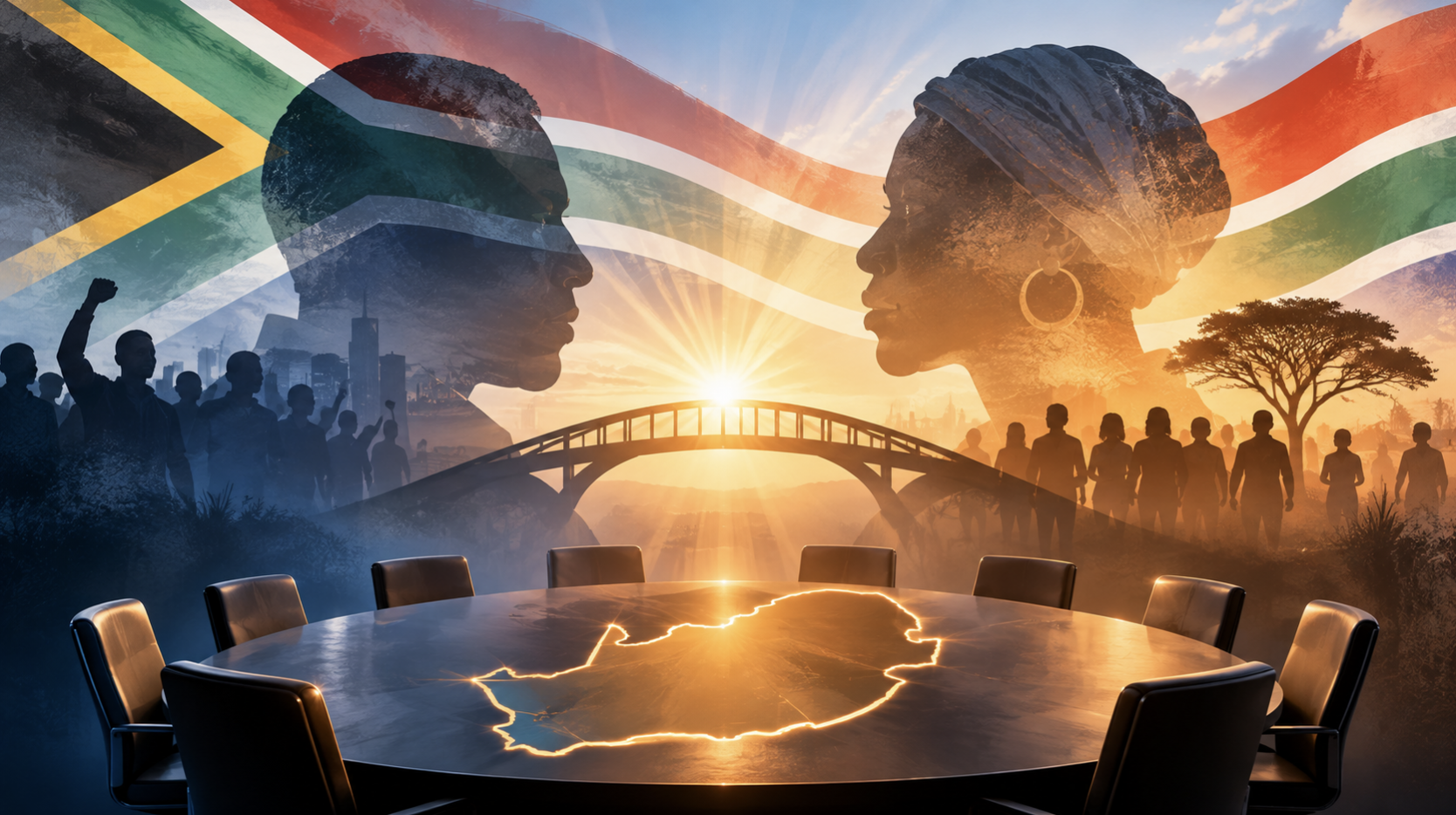
Remarks by Mohammed Bhabha, Director of the In Transformation Initiative and former Member of Parliament, delivered at the international conference “In Search of a New Regional Social Contract in the Middle East”, organised by the Center for Middle Eastern Studies (ORSAM) and the Global Orders Programme, Global History Centre, University of Oxford — Ankara, 9 November 2026.
I want to thank ORSAM and Oxford for inviting me. I am aware that I am the outsider on this panel, the South African among colleagues who know this region far better than I do. So I will not presume to assess Türkiye’s process. What I can do is tell you what we learned in ours, and let you decide what, if anything, travels.
1. The context, and the leadership it required
Before I talk about process, I have to talk about context, because the context is the reason we negotiated at all and the reason the settlement took the shape it did.
We used a phrase in our movement: colonialism of a special type. It sounds academic but it is not.
In classical decolonisation, the colonial power has a motherland to go back to. India had Britain. Algeria had France. The flag comes down, the administrators board a ship, and they go home.
In South Africa, our oppressor was going nowhere. He had no motherland to go back to, because he was already home.
And he was not weak. He commanded one of the most powerful armies in the world, battle-hardened in Angola and Namibia. He had built nuclear weapons, which he later dismantled as part of the transition. He had the police, the civil service, the courts and the economy in his hands, and the levers of state behind him.
But we had one thing. We had owned the streets. Through mass action, stayaways, boycotts and rolling defiance we had brought the country to a standstill. The economy had plummeted. The townships were ungovernable and everyone knew it.
So we reached an impasse. Neither side could win outright and neither side could leave.
Look at the two sides at that table, because both were driven by fear and both fears were rational.
On one side stood a powerful adversary who was afraid. He was afraid that majority rule meant retribution. He was afraid that if he handed over power there would be no place for him, for his language, his culture, his property, his children. That fear was not imaginary. It was the fear of a minority that had done terrible things and knew it.
On the other side stood an oppressed majority that was angry, not irrationally but righteously, after three hundred years of dispossession, of humiliation, of being used for its labour and nothing else. No leader could have told those people to set their anger aside and expected to keep their trust.
Two fears pulled in opposite directions, each one feeding the other. That is the trap in every divided society, because each side’s fear becomes the evidence for the other’s.
This is why the transition took mature leadership rather than cleverness at the table. It took the willingness to reach out to the enemy and start thinking of the country first, to rise above our own base instincts and start a dialogue. It meant reassuring a frightened minority without betraying an angry majority. Let me be clear about the anger. The anger was just. The only question was whether it could be disciplined into strategy rather than spent as revenge.
Reassurance, moreover, cannot be rhetorical. You cannot tell a frightened minority to trust you and expect it to work. Reassurance has to be built. That is what the bill of rights was for. That is what the constitutional court was for. They were not legal decoration. They were the price of a peaceful transfer and the guarantee that the transfer was real.
And so the most important agreement in South Africa was not the final constitution. It was the agreement on how we would talk to each other.
2. The process: private trust, then public promise
The dialogue did not begin in public. It began in private, in back channels, for two reasons.
The first was fear, specifically the fear of being called a traitor. If you are seen talking to the enemy before your own people are ready for it, you are not a peacemaker but a sellout, and your own constituency will destroy you before the other side gets the chance. The first contacts therefore had to be deniable. People had to be able to say, with a straight face, that no such meeting took place.
The second was timing. Talk too early and you negotiate from weakness, or are seen to, which is worse. Talk too late and the window closes. Back channels are how you find out whether the timing is right: whether the other side is serious, whether they can deliver their own people, whether a deal is possible at all. You cannot test any of that in public, because in public every exploratory question becomes a headline and every headline becomes a position you cannot retreat from.
So we built trust in private, slowly and deniably, with nothing written down that could be used against anyone. Only once that trust existed, once each side knew the other could deliver, was the moment right to go public.
When we went public we did not frame it as a concession. We framed it as an exciting future and as a promise. Each party had to be able to go back to its own constituency and say, look what this delivers for you, rather than look what we gave away. The settlement had to be sellable in the language of each side’s own aspirations, with the majority hearing freedom, dignity and a vote, and the minority hearing safety, language and a place. Same document, two different speeches. That is not dishonesty. It is what it takes to bring two frightened constituencies into one country.
The public process is where agreements are ratified. The back channel is where they are incubated. It was never a substitute for the public process but always in service of it.
Once the process was public we operated on sufficient consensus, which meant that no single party could veto but no majority could simply impose. That principle is easy to state and very hard to live, because it meant the strong had to wait and the weak had to compromise.
We held to it under fire. There was more violence during the negotiations than before them, and spoilers from the right and from the left tried to derail the process. The only way to squeeze them out was to have one voice on the commitment to the process even when the parties disagreed on everything else. That is a hard discipline. It means defending the process even when you distrust the person across the table.
I want to stop here, because this is the part that gets lost when people tell the South African story.
The constitution is what the world remembers, but the constitution was the outcome, and the outcome was never the hard part. The hard part was building a process that both sides would stay inside, through violence, through provocation, through walkouts, through the moments when the cameras were off and the temptation to leave the table was enormous.
A good process can survive bad leaders, while a bad process will destroy good ones. A process that people helped design is a process they will not easily walk away from. That is why we spent so much time on the how. Not because we were procedural people, but because we understood that if the how was right the what would follow, and if the how was wrong no what could save us.
On transferring any of this
I want to be careful here. I am not telling you that your situation is ours, because it is not. I am not going to grade your processes or tell you which of your problems resembles which of mine. I do not presume to assess them, and I would be a poor guest if I tried.
What I can tell you is which process questions we found we could not avoid.
Who talks first, and how do they do it without being destroyed for it? Who convenes, and who is in the room, and just as important, who is not? What is the rule for deciding when no one can veto and no majority can impose? What do you do about the people who want the process to fail? And how does each side go back to its own people and sell what was agreed, in language those people can hear?
None of these questions is about the content of the settlement. All of them are about whether a settlement is reachable at all. Get the process wrong and the best outcome on paper dies in the street. Get it right and imperfect people can produce something that holds.
Those questions do not belong to South Africa. They belong to anyone trying to move from a divided past to a shared future, and what you do with them is yours.
3. The strong centre: what the process had to produce
If process was the achievement, what did our process actually have to produce?
Apartheid was designed to elevate ethnic identity. It created homelands on the basis of ethnic identity and it used Black people for their labour and nothing else.
Ethnicity under apartheid was not a recognition of who people were. It was a machine for excluding them. The so-called homelands were built to strip Black South Africans of citizenship in the country they lived and worked in. If you belonged to a homeland you were a foreigner in white South Africa, there only to work. Pass laws, influx control and migrant labour all ran on one idea: that your identity determined your rights and your labour was all you were for.
The system weaponised identity to divide people who might otherwise have made common cause, and it reduced a majority to a workforce.
This meant we could not answer apartheid with ethnic federalism, or with a deal that parcelled power out to groups. That would have accepted apartheid’s own categories. It would have said that ethnicity is the fundamental political fact, and we had to refuse that premise.
So our answer was deliberately the opposite. We recognised culture, language and tradition, but tied that recognition to equal citizenship for every individual rather than to group entitlement. The rights came with citizenship, not instead of it.
Now, inclusivity, trust and ownership are three words people use loosely, so let me say what they meant to us.
Trust gets you to the table, but trust is fragile. It is a feeling between individuals, and individuals change. Trust alone cannot hold a country.
Inclusivity is what makes the table worth sitting at. If you are brought in only to be told what has already been decided, you are not included but informed. Inclusion means the excluded have a hand on the pen.
Ownership is what turns a settlement into something people will defend. Ownership means that this is mine. Not that it was done for me, and not that I accept it because I have no choice, but that I helped write it, that my fingerprints are on it, and that if it falls then something of mine falls with it.
That is the sequence. Trust gets you to the table. Inclusivity keeps you there. Ownership is what you leave with, and it is the only thing that survives after the negotiators go home.
This is what a strong centre is. It is not a strong central government that decides for everyone. It is a centre of gravity, a set of rules and institutions that both sides had a hand in writing and therefore both sides have a stake in defending. That is what squeezed out the spoilers, not force but ownership.
Crucially, we did not leave the protection of cultural and linguistic rights to the goodwill of the political majority. We assigned it to institutions.
A constitution means nothing, literally nothing, unless the institutions that hold its values are credible. You can write the most beautiful bill of rights in the world, but if the courts are captured it is paper, if the electoral commission answers to the incumbent it is paper, and if the auditor-general can be fired for doing his job it is paper. The document is not the guarantee. The institution is.
So we put the guarantee beyond the reach of any one government, beginning with an independent judiciary above all, because the courts are where the values of the constitution stop being a promise and become a ruling that even a president must obey.
Then came the bodies we call Chapter 9 institutions: the Public Protector, the Human Rights Commission, the Electoral Commission, the Auditor-General, and the Commission for the Promotion and Protection of the Rights of Cultural, Religious and Linguistic Communities. They have fixed terms, independent budgets and public reporting.
That last one closes a circle. Apartheid weaponised ethnicity, so we built a permanent institution whose only job is to protect cultural, religious and linguistic communities, not by giving them group rights but by protecting the people within them. We answered the machinery of division with the machinery of protection.
All of this answers the question every delegation here is asking, which is who guarantees it when the politics change. The answer is not a promise. The answer is an institution. And an institution is only worth what its credibility is worth. That is why the independence of the judiciary is not one issue among many. It is the load-bearing wall, and if you take it away the rest of the building comes down on everyone inside it.
4. The proof: a process that outlived its authors
Does this architecture work when tested? Ours has been tested.
President Mbeki was removed by his own party and resigned. There was no constitutional crisis and life went on. President Zuma was not removed by a mob. He was removed as a consequence of an institution, the Public Protector’s findings, upheld by the courts, and again life went on.
The lesson is not that we had perfect leaders. It is that the process we built outlasted the people who built it. Our Constitutional Court has ruled against the government of the day, against the President and against Parliament, and its rulings have been obeyed. That is the test, not the elegance of the document but the obedience to it when it is inconvenient.
Because we had that, we could make a difficult decision about sequencing. There was great eagerness to get the Truth and Reconciliation Commission going from the onset and we had to curtail that eagerness. Had we done truth telling before agreeing on the rules of the new state it would have torn us apart.
I will not pretend the TRC finished the work. Its promise remains unfinished, and we are still grappling with reparations and with the deeper social justice it demanded. But sequencing the settlement first was necessary to stop the process collapsing before it began. Order is not delay. Order is how you protect a process while it is still fragile.
5. The price: bringing your people with you
I want to share the hardest lesson I learned personally, which is the value of bringing your constituency on board.
When you bring them on board they feel respected and included, but it also does something practical, because it makes it easier to temper their expectations. You cannot ask your people to accept a painful compromise if you have kept them in the dark. If they feel part of the process, then when you tell them that we cannot get everything we want they will hear you. They will trust you because you trusted them.
There is a harder lesson underneath this one, and it took me years to learn it. Never underestimate the intelligence of our people, and never underestimate the value of taking them along.
People in the street can smell condescension. They can tell when they are being managed, when a decision has already been taken and they are being asked to applaud it. They will forgive you for telling them a hard truth. They will not forgive you for treating them as children.
The people in the street must be consulted, not informed but consulted. When you consult them honestly two things happen. You get information you did not have, because they live with the consequences of what you are negotiating, and you build the only asset that makes a painful compromise survivable, which is their trust.
That is also how you manage expectations. You do not hide the compromise until it is too late. You bring people along so that when you say we cannot get everything we want, they hear a leader who has been honest with them rather than a leader who has just sold them out.
You cannot negotiate in secret and then sell a deal. The sell is part of the negotiation.
There was something else as well. We were tired. After three hundred years of dispossession and apartheid we were exhausted, and the cost of continuing the conflict had become greater than the cost of compromise. That exhaustion is not a weakness. It is a resource, because a society tired enough of its own history becomes willing to do the hard work of building a new one. But exhaustion is not agreement. It is only the condition that makes agreement possible, and it must be used rather than wasted.
Conclusion
So the lesson I would leave you with is this. Peace is made less at the signing than in the years of implementation, and a social contract lasts only when the formerly excluded come to feel like full citizens. That is the test. Not the document, but the feeling.
I want to end on a single night.
On the 10th of April 1993, Chris Hani was assassinated. We were still more than a year from the first democratic election and the transition was fragile. The country could have exploded.
It did not.
The centre held, not because of a miracle but because of the work. Because we had put the country first. Because we had been prepared to speak to the enemy. Because we had built something people believed was theirs to defend.
So the question I leave you with is this. What is the small, untidy work you can do now, before the night comes, so that your centre holds?
Mohammed Bhabha was a member of the South African Parliament and a participant in the constitutional negotiations that ended apartheid. He is Director of the Intransformation Initiative.