
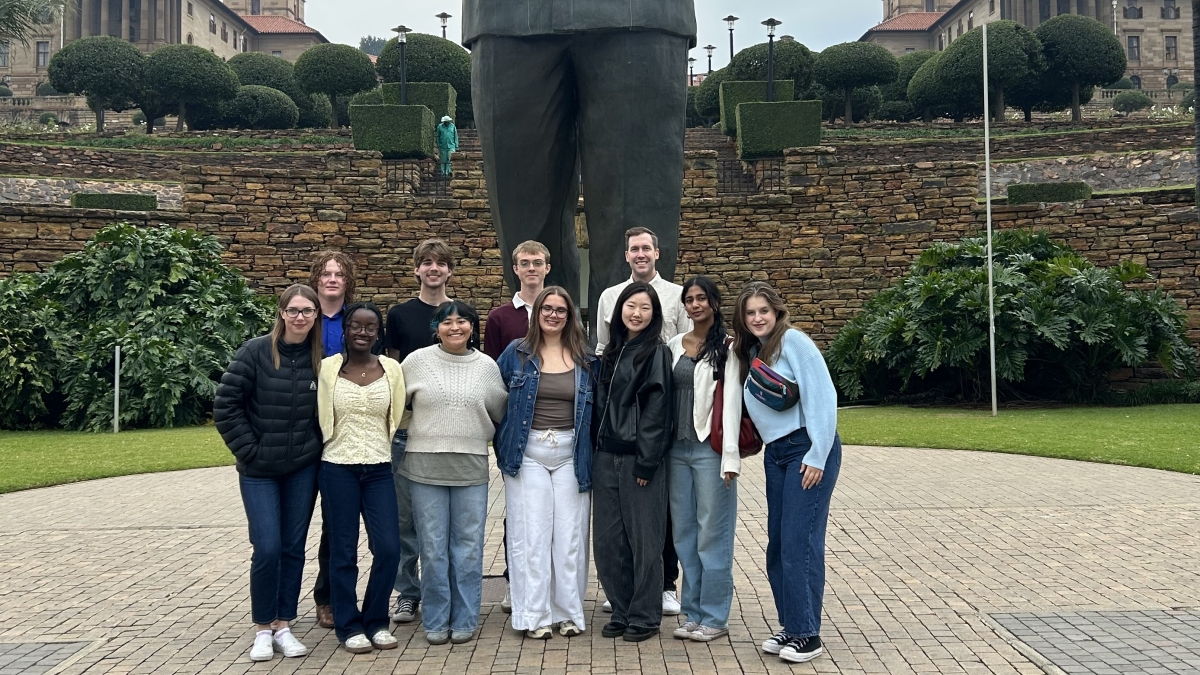
Global Ties That Bind pairs Barrett students with peers in South Africa to enrich honors research
By Luz Capiral |
August 21, 2026
Barrett, The Honors College is giving students a new way to develop their honors theses by combining academic research with firsthand experiences in South Africa.
Through Global Ties That Bind, a Global Resolve initiative connecting Arizona State University with the University of Pretoria and the In Transformation Initiative, the inaugural cohort of 10 Barrett students partnered with 11 honors students at the University of Pretoria to explore how international collaboration could shape both their research and their understanding of the world.
The program is a three-in-one honors thesis pathway that integrates collaborative coursework, faculty-guided research and international mobility. Throughout the academic year, students develop their research interests and learn research methods before applying those skills through direct engagement with people, institutions and communities in South Africa.

Beyond supporting student research, the initiative brings together higher education and civil society to create opportunities for knowledge sharing between partners in the United States and South Africa, while addressing shared challenges related to human rights, democratic ideals, access to justice and peaceful coexistence. The program aligns with the university’s priorities around preparing students to address complex global challenges through use-inspired research, collaboration and experiential learning.
“We really wanted them to get a sense of the historical connections between the U.S. and South Africa from the founding of both countries to how both countries have evolved socially, culturally and politically,” said Kayode Odumboni, assistant teaching professor and Honors Faculty Fellow. “All through the semester, we’re actively thinking of how they can learn more about both countries, historically and politically, and use that knowledge to articulate a research agenda that is uniquely theirs.”
Rather than conducting research solely in the classroom, students refined their projects through conversations and experiences. Faculty members said many participants returned with new perspectives that reshaped their research questions and broadened their understanding of the topics they were studying.
For Neha Bhavanam, an economics and international relations major in the School of Politics and Global Studies and The College of Liberal Arts and Sciences, the experience shifted the focus of her honors thesis.

“My thesis originally focused on fiscal policy, economic allocation and public funding,” Bhavanam said. “While the economy remains important, throughout my two weeks in South Africa, I became more interested in how policy shows up physically in people’s daily lives. I now want to focus on tangible issues like infrastructure, township planning, access to transportation and city planning. My experience in the program helped me see how inequality is not just an economic issue, but something built into roads, housing, rail systems, land use and access to opportunity.”
The result is a range of honors thesis projects focused on issues such as food security, informal employment, sustainable agriculture, green technology transfer, urban development and critical mineral supply chains. Each student pursues an individual area of study while working alongside faculty mentors and peers in both countries.
For Carina Lanier, an international trade and global management major in the Thunderbird School of Global Management, the program provided an opportunity to connect her honors thesis research with firsthand experiences in South Africa.

“My thesis project is a policy brief focused on youth nutrition within a school context,” Lanier said. “At this stage of my research, I am examining how school nutrition programs and agricultural initiatives can support students’ educational outcomes. Through the Global Ties That Bind program, I learned firsthand about school feeding programs, agricultural processes and educational challenges in South Africa.”
The collaboration also gave students opportunities to learn from one another through conversations, shared experiences and cultural exchange.
“Every interaction with the students at the University of Pretoria was eye-opening,” said Madeline Yang, a political science major in The College of Liberal Arts and Sciences. “Asking question after question about their lives, lived experiences and explanations of how systems in South Africa worked was a cultural exchange beyond value.”

During their time in South Africa, students met with government officials, diplomats, civil society organizations and business leaders to learn about international relations, public policy and community development. Those interactions broadened students’ understanding of how global issues affect communities and individuals while reshaping how many viewed their own research and the role they could play in addressing complex challenges.
“Programs like Global Ties That Bind provide students with the opportunity to broaden their perspectives and carry those experiences with them into whatever career path they choose after they leave Barrett,” said Jason Briggs, senior director of Barrett, The Honors College global initiatives. “We hope they leave with a deeper understanding of other people and cultures, a greater awareness of what’s happening around the world and how it affects all of us, and a stronger sense of their own role in addressing global challenges. Most importantly, we want them to know they don’t have to stand on the sidelines — they can have a voice, make meaningful contributions and help shape a better future.”
Interested in participating? Click here to learn more about Global Ties That Bind, future cohorts and other global learning opportunities through Barrett, The Honors College.